
Underkeep Exploration: Tools, Secrets and Fast Travel
How Underkeep exploration works: which tools open which obstacles, how to search walls and graves, food and resting, and Waystone fast travel.
Underkeep exploration runs on three resources: tools that open obstacles, food that pays for resting and grave digging, and map notes that remember what you found. Miss any one and the dungeon stops giving up its secrets.
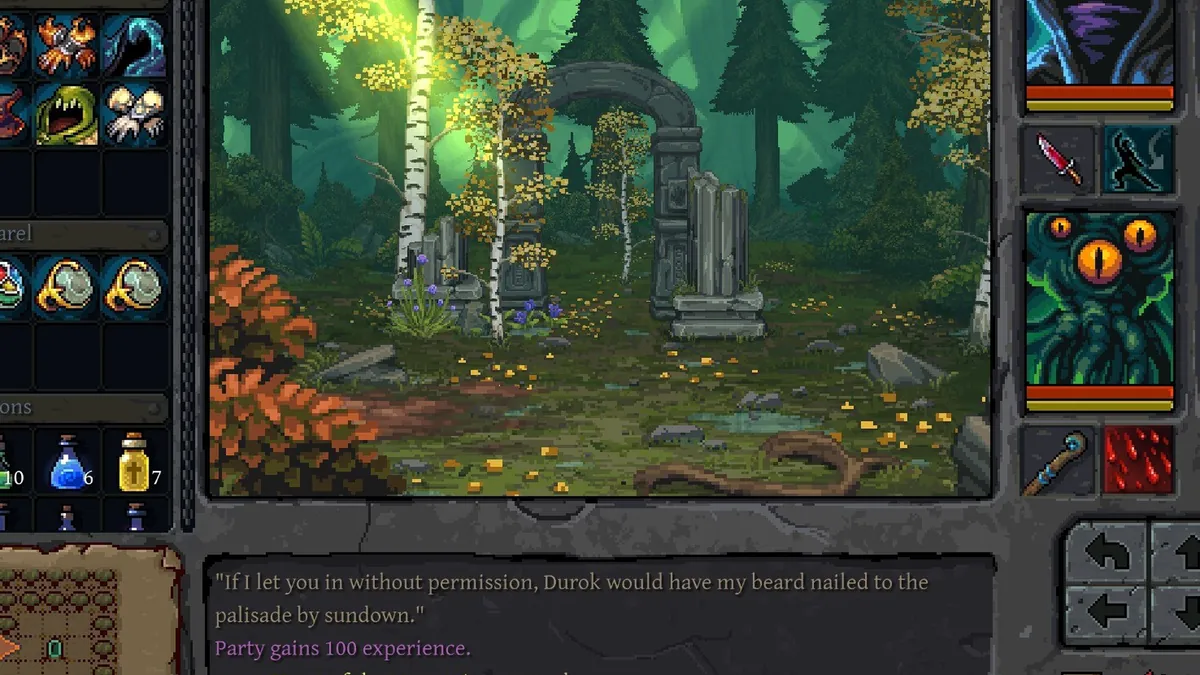
Which tools open which obstacles?
| Tool | Opens | Notes |
|---|---|---|
| Pickaxe | Collapsed rocks | Some rocks need the Reinforced Pickaxe |
| Shovel | Graves | Each dig costs food |
| Golden Chisel | Gold veins | Found or bought before the first vein |
| Lockpick Tools | Locked chests | Consumable in practice; carry spares |
| Mortar and Pestle | Alchemy and cooking | Required for every recipe |
Buy the pickaxe and shovel before the first real dungeon. The pickaxe turns dead ends into routes, and the shovel turns graveyards into gold, gear, and occasionally a fight. The Golden Chisel and lockpicks are optional until you find the obstacle that needs them.
How do you search a room?
Search in a fixed order so you do not walk past loot. Start with the walls, then the floor, then the containers.
- Hug the wall and look for a dead-end segment with no door.
- Listen for stone sliding when you press against it; that sound is the hidden-wall tell.
- Check garbage piles, hollow trees, alcoves, and tombstones.
- Step on pressure plates and push suspicious objects.
- Break fragile objects; some contain items rather than noise.
- Read signposts. They often point at a route rather than a joke.
The automap records doors, treasure, statues, pressure plates, pits, rocks, shrines, teleports, and portals. Add your own notes the moment you find something you cannot open yet. A note costs a second; backtracking costs ten minutes.
How does food work?
Food is one shared number for the whole party. Resting consumes it, grave digging consumes it, and you cannot rest while enemies are nearby. That makes food a dungeon timer, not a shop item.
Carry more than you think you need. Twenty units disappears fast when you rest after every hard fight. Cooking stews and toast with the Mortar and Pestle stretches the same ingredients further, and cooked food is worth the detour once you have a recipe.
When food runs low, leave the dungeon. Do not push into a boss room with an empty pantry; a wiped party loses more than the walk home.
Resting with disease gives you nothing. Cure it before you spend food on a rest, or you pay twice.
How does fast travel work?
Touch every Waystone Gate you pass. Once a gate is activated, you can travel between activated gates instead of walking the route again. The first activation also unlocks the Way to Go! achievement.
Activate gates even when you do not need them yet. The return trip is where most players lose time, and a gate you skipped is a gate you have to walk back to.
What should you explore first?
Clear the starting dungeon, return to the village, then push west into Hollowgrave Tunnels. The tunnels teach the three exploration verbs: light, dig, and listen. After that, the map opens in several directions and you can choose by reward rather than by level.
| Stage | Area | What to look for |
|---|---|---|
| 1 | Starting dungeon | Tools, food, first gear |
| 2 | Underkeep Village | Shops, revival statue, quests |
| 3 | Hollowgrave Tunnels | Silver Key door, ore, graves |
| 4 | Fangroot pits | Herbs, animal fights |
| 5 | Orc Camp | Chieftain chest, Silver Key |
| 6 | Gravewood Crypt | Optional gargoyle puzzle |
| 7 | Duskhollow Woods | Later quests, mist routes |
The map page→ lists the connections between these areas. If you are stuck on a specific wall, the hidden walls page→ covers the detection rules in detail.
What is worth the detour?
Gold veins, locked chests, and one-way treasure rooms are worth the trip. A grave with a good item is worth it; a grave with three coins is not. Decide by the cost in food, not by curiosity.
Recipes are the best detour. A single alchemy recipe can replace a stack of potions, and permanent boosts such as the mana increase are worth more than any single piece of gear.
FAQ
Do you need every tool to finish Underkeep?
No. The pickaxe and shovel cover most routes. The Reinforced Pickaxe, Golden Chisel, and lockpicks open optional treasure and shortcuts.
Can you rest anywhere?
Only where no enemy is nearby. The game blocks resting in active rooms, so clear the room first.
Does the map fill in automatically?
The automap fills as you walk. Notes and markers are manual, which is why you should mark blocked doors and unopened chests immediately.
Official source: Underkeep store page ↗
Community source: Steam community player guide ↗
Official source: Underkeep news hub ↗
More Underkeep Guides
All seven Underkeep classes explained: main stat, resource, front or back row, weapon requirements, and the race that fits each one.
How Underkeep combat works: one action per hero, free actions, damage and armor math, crit and evasion formulas, status effects, and turn order.
What is confirmed about Underkeep endings: multiple outcomes, the quests that matter, why special dialogue is not always best, and how to save for branches.
Underkeep equipment explained: weapon types per class, armor slots, how armor and sharpness change damage, which tools share the budget, and when to upgrade.
The Underkeep first party for a blind run: four heroes, race picks, early skills, gear priorities, and the first purchases that keep the run alive.
How Underkeep front row and back row positioning works: who can melee, when Reach bypasses the rule, what swapping costs, and the safest four-hero layout.
What to do when the four gargoyles get stuck in Underkeep Gravewood Crypt, why there is no reset lever yet, and how to recover without losing the run.
A spoiler-light Underkeep guide hub: what to do in the first hours, which systems matter, and which of our 25 pages answers your question.