
Underkeep Combat: Turn Order, Damage and Status
How Underkeep combat works: one action per hero, free actions, damage and armor math, crit and evasion formulas, status effects, and turn order.
Underkeep combat is a grid-based turn game where each hero gets one action per round, potions are free, and the combat log tells you exactly why an attack failed. The side that spends fewer actions on healing wins.
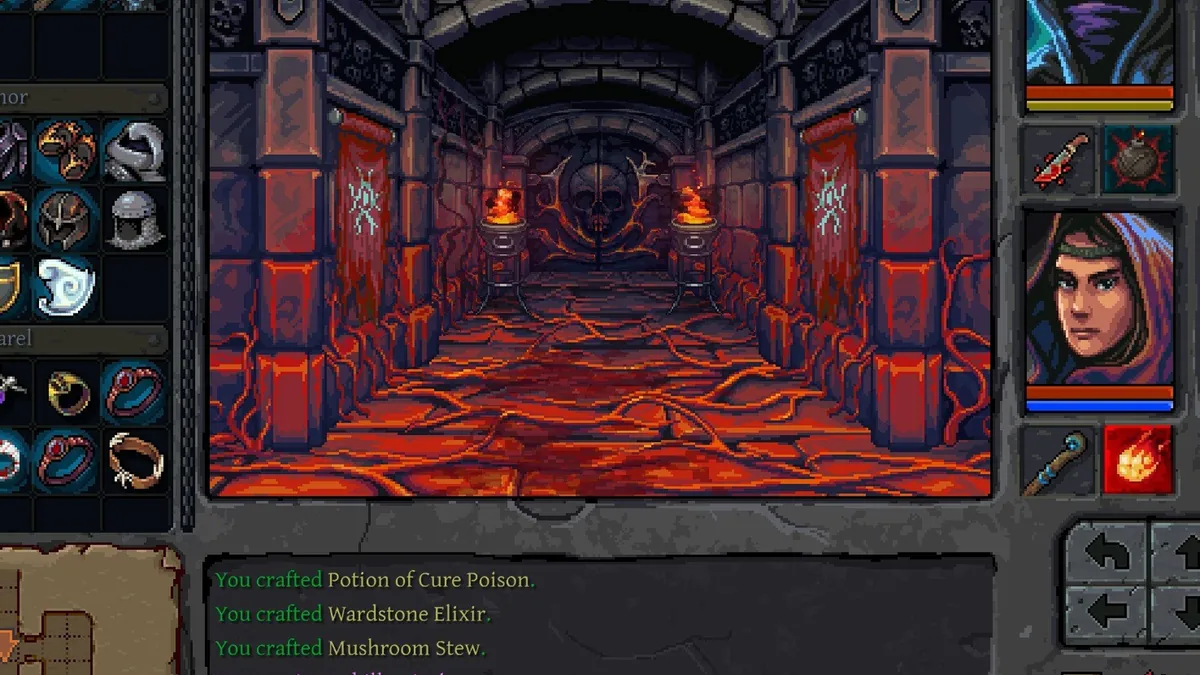
How does a combat round work?
Every hero gets one action: a basic attack or an assigned active skill. Items, including potions, do not consume the action. A few skills are also free actions, which makes them the strongest buttons in the game.
The round ends when every hero has acted or when you press the hourglass. After any hero acts, the party cannot move until the round ends. That rule is why positioning has to be decided before the first attack, not in the middle of the round.
| Action type | Costs the turn? | Examples |
|---|---|---|
| Basic attack | Yes | Weapon hit |
| Active skill | Yes | Fire Spark, Lay on Hands |
| Item | No | Healing potion, cure potion |
| Free-action skill | No | Champion's Grip, Righteous Strike, Evasive Roll, Skirmisher's Step |
| Row swap | Yes | Move a hero forward or back |
Free actions are not free resources; they still cost stamina or Zeal. They are free in the action economy, which is the part that decides fights. The skills page→ marks every free action by class.
How is damage calculated?
The game uses flat armor subtraction, not percentages.
- Base damage = STR / 2 + weapon damage + bonuses.
- Physical damage = base damage − target armor + Sharpness.
- Critical damage = ×1.75.
- Melee crit chance = DEX / 10.
- Ranged crit chance = DEX / 7.
- Ranged hit chance = DEX × 10 − enemy evasion.
- Evasion = DEX × 2%, capped at 60%.
Two conclusions follow. First, armor is strongest against many weak hits and weakest against one large hit. Second, DEX is both an accuracy stat and a crit stat, which is why Thief and Ranger scale so well with it.
Magic does not use the physical formula. Each spell has its own damage range and resistance check, and WIS provides 2% fire, ice, lightning, and poison resistance per point. Blood magic resistance comes from END instead.
Why does the combat log matter?
The log names the exact failure: miss, out of reach, immune, resisted, or no valid target. Reading it saves whole runs.
If an attack says Out of Reach, the hero is in the wrong row or the weapon lacks Reach. If a status never lands, the enemy is immune; stop spending actions on it and switch to raw damage. If a heal does nothing, check for Disease or a healing reduction effect.
Many bosses ignore stun. Test with a cheap skill before you build a plan around control.
Which status effects matter?
| Status | Effect | Cure |
|---|---|---|
| Poison | Damage each round, minimum 1 | Cure Poison potion, Void Mend Lv4 |
| Burn | Fire damage each round | Frostvein Draft, Void Mend Lv3 |
| Freeze | Skips the round | Frostvein Draft |
| Bleed | HP loss each round | Void Mend Lv2 |
| Stun | Cannot act, does not stack | Thunderwake Draught, Void Mend Lv5 |
| Paralyze | Cannot move but can attack | Thunderwake Draught |
| Blind | −50% hit chance | Wait it out |
| Disease | No recovery while resting | Cure before resting |
| Mental Fog | No skills for a few rounds | Wait it out |
| Slime Corrosion | Armor reduced | Wait it out |
Bleed and poison are damage-over-time effects, so they favor long fights. Stun and freeze are tempo effects, so they favor burst. Paralyze is unusual: the target can still attack but cannot move, which matters when the whole party is stuck in place.
What is the best turn order?
Open with free actions and debuffs, then spend the round on focused damage. A typical round looks like this:
- Paladin uses Righteous Strike as a free action and builds Zeal.
- Voidcaller applies Unholy Convergence or refreshes an aura.
- Ranger marks the priority target with Hunter's Prey.
- Warrior uses Champion's Grip, then hits.
- Wizard casts the element the target is weak to.
- Thief finishes a bleeding target with Shadow Lunge.
The exact order depends on who is in danger, but the principle is stable: buffs and marks first, damage second, healing only when someone would otherwise die.
How do you handle a losing fight?
End the round and retreat while you still have actions. A retreat costs progress, not the run. If a hero is down, decide whether to revive in combat or fall back; reviving into the same losing position just spends resources twice.
Against undead, stop relying on bleed and poison. They ignore both, and fire is the reliable answer. Against animals, Elk armor helps the front row. Against armored orcs, Sharpness and armor-ignoring skills are worth more than raw damage. The bosses page→ applies these rules to the named fights.
FAQ
Is there a turn order initiative stat?
The game does not expose an initiative stat in the tooltips covered here. Heroes act once per round, and the hourglass ends the round early.
Do potions really not cost a turn?
Correct. Potions and inventory items are free actions. That is why carrying cures is stronger than carrying one more damage item.
Why did my attack miss?
Check the combat log. Common causes are low DEX against an evasive enemy, blind, or attacking from the wrong row without Reach.
Community source: Steam community player guide ↗
Official source: Underkeep on Steam ↗
Official source: Underkeep news hub ↗
More Underkeep Guides
All seven Underkeep classes explained: main stat, resource, front or back row, weapon requirements, and the race that fits each one.
What is confirmed about Underkeep endings: multiple outcomes, the quests that matter, why special dialogue is not always best, and how to save for branches.
Underkeep equipment explained: weapon types per class, armor slots, how armor and sharpness change damage, which tools share the budget, and when to upgrade.
How Underkeep exploration works: which tools open which obstacles, how to search walls and graves, food and resting, and Waystone fast travel.
The Underkeep first party for a blind run: four heroes, race picks, early skills, gear priorities, and the first purchases that keep the run alive.
How Underkeep front row and back row positioning works: who can melee, when Reach bypasses the rule, what swapping costs, and the safest four-hero layout.
What to do when the four gargoyles get stuck in Underkeep Gravewood Crypt, why there is no reset lever yet, and how to recover without losing the run.
A spoiler-light Underkeep guide hub: what to do in the first hours, which systems matter, and which of our 25 pages answers your question.